Showing posts with label Jane Austen. Show all posts

Friday, 7 August 2020

When the sukebind is in bud ...


Delicious new cover for the Penguin Modern Classics edition of Cold Comfort Farm.  I've never found this book quite as amusing as is often claimed.   Probably because  I am very fond of one of the novels it parodies (Mary Webb's Precious Bane) but there is lots to love about this 1932 classic.

Flora Poste is an elegant bluestocking, remarkably self-assured for a nineteen year old but her moments of self-doubt and kindness keep the reader on her side as she descends on Cold Comfort Farm to drag the unwilling inhabitants into the twentieth century.

I liked Mrs Beetle, wife of Agony Beetle and mother of Meriam the hired girl who falls pregnant 'when the sukebind* is in bud' and has produced several babies.  Flora advises Meriam on contraception and Mrs Beetle offers her own advice:
Anyway, we know now, thanks to Miss Interference from up the 'ill. And I'll lay she's no better than she ought to be, a bit of a kid like 'er sailing in 'ere as bold as brass and talkin' to you about such things.  Still, she does look as if she washed 'erselef sometimes, and she ain't painted up like a dog's dinner, like most of them nowadays.  Not that I 'old with wot she told, you mind you, it ain't right. 
I really liked all the Jane Austen references.  The novel's dedication comes from Mansfield Park 'Let other pens dwell on guilt and misery' and  begins with Flora's position in the world and financial prospects which is also typical of the beginning of an Austen novel.  I suppose her interfering nature makes her a little like Emma, but Flora does not have Emma's wealth and status.  She does however intend to write a novel as good as Persuasion when she is 53.

Sukebind is a flower invented by Stella Gibbons to symbolise human lust!

Tuesday, 15 May 2018

Jane Austen - The Chawton Letters


Well - I am come home from Mrs Lyson's as yellow as I went, you cannot like your yellow gown half so well as I do, nor a quarter neither. Letter to Cassandra. May 1801

Jane Austen’s letters clearly weren’t written with one eye on posterity so it’s always a slightly uncomfortable experience reading them.  As Anne Elliot ponders in Persuasion 'no private correspondence could bear the eyes of others.' This beautifully presented Bodleian Library publication is edited by Kathryn Sutherland and includes intriguing analysis of the way the letters were folded, sealed and cross-written along with examples of Austen’s exquisite handwriting. 
 
Austen’s letters consist largely of domestic concerns, whinges about the weather, shopping, gossip about relatives and acquaintances and then you suddenly come across a concise observation which reminds you what a great writer she was.

My favourite letter in this collection was written to Cassandra on 24th January 1813 from Chawton cottage,  Jane is reading a publication about the Military Police and Institutions of the British Empire by Captain Charles Pasley of the Royal Engineers which she was initially reluctant to receive but is completely won over by the writer's wit and style and describes him as 'the first soldier I ever sighed for.'

Of course, in 1813, Pride and Prejudice was about to be published and her growing exuberance about her 'own darling Child' is charming to read.

Planning to re-read any Austen over the summer?

Thursday, 12 October 2017

A Life of My Own


Claire Tomalin's 1997 biography of Jane Austen is generally thought to be one of the best - extensively researched, clear-sighted and affectionate.  I particularly liked her thoughts on Persuasion:
The warmth and softness of the book is all Anne Elliott's in her responses to people, landscape and season, she and Marianne alone among Austen heroines cherish the beauty and sadness of autumn.
I'd not made a connection between Anne Elliott and Marianne Dashwood from Sense and Sensibility before.  That's the thing with Austen, the more you read, the more you see.

Claire Tomalin has just published a biography of her own life which makes for fascinating reading.  There are chapters devoted to her early life with a French father and musical mother, her undergraduate days at Newnham, Cambridge, her marriage to the journalist Nick Tomalin who was later killed on assignment in Israel leaving her to raise three daughters and a young son with disabilities.  There is also a very moving chapter on the loss of one of her daughters who was a student at Oxford.

Despite personal tragedy Tomalin continued to work as a book reviewer and editor with a strong belief in the importance of critical discourse and the power of good writing.  At the age of 53 she left the Sunday Times where she was literary editor and began to write widely acclaimed literary biographies and finds personal happiness when she marries again.

I always like to re-read Persuasion in the autumn, what are your seasonal reading plans?   

Monday, 28 August 2017

Jean Hanff Korelitz


I do like the writing style of Jean Hanff Korelitz. She has a gift for describing clothes and food and interiors and I like all that detail. You may be familiar with Admission her enjoyable 2009 novel about the competitive world of Ivy League college admission. The new novel The Devil and Webster returns to academia and the central character is Naomi Roth whose career trajectory has taken her from professor to dean to President of Webster, a New England college with a rising reputation. Politically engaged, Naomi has raised a strong-minded daughter, Hannah, now a sophomore at Webster.

When a student protest arises after a popular professor is 'let go’ following a plagiarism charge Naomi - perhaps nostalgic for her own student days - allows it to go on too long and gain too much momentum and it begins to threaten her relationship with her daughter and her own career.

Well, what I thought would happen in this novel did happen and then something I wasn’t expecting also happened so I was rapidly turning the pages until the end! I loved this description of Naomi lying in the bath trying to read a much-hyped novel by a former graduate:

She climbed into the deep 1920s tub, and the rising heat made it ever more difficult to follow the novel’s story: a missing briefcase full of something. A formula? A code? The paper-thin female character, decribed with a leering male eye, insufferably perky. She hoped that the author did not go around crediting the creative writing teachers he’d studied with a Webster, nof for this. A car chase, cinematically described. The hero’s name was Chance. Of course it was. Jean Hanff Korelitz

I’ve been to Brighton for my daughter’s graduation ceremony and I also managed to catch the Jane Austen By The Sea exhibition at Brighton Pavilion. It was amazing to see drafts of Sanditon in her meticulous handwriting and very poignant to see a lock of her hair which had faded from its original auburn to blonde.  It's a small exhibition but worth seeing and it's on until January 2018. 

Wednesday, 14 December 2016

Seasonal reading


Next year will be the bicentenary of the death of Jane Austen and there are one or two events which have caught my eye.  In January The British Library will be putting on an exhibition of her teenage writings and opinions on her books from friends and family.  It's a wonderful opportunity to see her exquisite handwriting.  2017 will also be the bicentenary of Persuasion and if I was in North Carolina I would love to go to this.  I was also interested in the news this week that the attractive Rice portrait, said to be of Jane Austen, went on display to members of the Cambridge Jane Austen Society.  I must either join a Jane Austen society or start one in my area!

I've just read Rachel Cusk’s Transit which is the second volume of a trilogy which began with Outline in which a writer travels to Athens to teach a creative writing course following a relationship break-down. Beyond the fact that she is a wife and mother and her name is Faye we are told little about the narrator and Transit is relayed in the same spare style:
 
In that time I studied the cafe’s interior. With its bookshelves and aubergine-painted walls and antique furniture, it gave an impression of age and character while being, in fact, both generic and new.
The writer has now moved back to London with her sons and she begins the process of renovating a London house but has to contend with a deeply unpleasant couple who live in the basement of the property.  Episodes in her daily life - some sad, some funny - are relayed in a deadpan style.  She participates in a literary festival where the guest writers get soaked running to the tent in the rain and later gets propositioned by the Chair. A visit to the hairdresser where the brilliantly lit opulent interior of the salon contrasts with the dark winter’s day outside and the heavy traffic on the streets rattle the hair products on the glass shelves. Conversing with her Albanian builder, meeting a friend for coffee who seems to thrive on chaos and is actually exhilarated when the sprinkler system accidentally comes on in her apartment and soaks all her belongings. In the final chapter, amidst a nightmare dinner party, we get some insights and reflections on the ending of the narrator’s own marriage.

I would recommend this beautifully written novel and I look forward to the third volume.  To escape the seasonal commercialism I think I will re-read Emma.  What are your reading plans?

Tuesday, 11 October 2016

Austen's unsung heroine

Female economy will do a great deal my Lord, but it won’t turn a small income into a large one. The Watsons, Jane Austen

We don't know why Jane Austen didn’t finish the novel later known as The Watsons but she had certainly thought it through because she told her sister Cassandra how the story would develop.
 
Reading the remaining early chapters we get a tantalising glimpse of Emma Watson who could have become one of Austen’s great heroines. Raised by her wealthy aunt and uncle she is educated and refined only to be sent back to her impoverished family when her uncle dies and her aunt hastily remarries.
 
Back in her own family with a dying father, two younger sisters desperate to get husbands and the 'hard-hearted prosperity’ of her brother and sister-in-law (reminiscent of John and Fanny Dashwood in Sense and Sensibility) Emma’s only comfort is her stoical and kind elder sister Elizabeth. There is a charming scene in a ballroom where a ten-year old boy is desperate to dance and Emma offers herself as a partner.
 
There has been much speculation as to why the novel was never completed. Some have suggested that the death of Austen’s own father meant that she couldn’t continue and others that the grim realities of the marriage market for women of no means too closely resembled the circumstances of Jane and Cassandra. The fragment that remains is unmistakeably Austen and just as you find yourself getting drawn into the story it ends.
 
In her 1948 biography of Jane Austen, Elizabeth Jenkins refers to the way her characters in The Watsons ‘grown into life before our gaze as she makes her magic passes too rapid for the eye to follow.’ Wouldn’t it  be wonderful if we had a seventh completed novel?

Sunday, 12 June 2016

Eligible

 
Even if her mother couldn’t recognise it, the shorts she had on were extremely stylish, as were her sleeveless white blouse and straw sandals. Curtis Sittenfeld
 
Despite my reservations about Austen prequels, sequels and re-imaginings I have to say I quite enjoyed Curtis Sittenfeld’s Eligible. Sittenfeld has re-worked Pride and Prejudice so that Mrs Bennet is a social climbing shopaholic, Jane a yoga teacher, Liz a journalist, Kitty and Lydia are glamourous vain, crude and addicted to CrossFit and pseudo-intellectual Mary is as unappealing as in the original.

If you know Pride and Prejudice it’s fun to spot the similarities and differences. The novel begins with Chip(!) Bingley, a graduate of Harvard Medical School, arriving in the neighbourhood having reluctantly appeared on a reality show called Eligible to find the perfect partner. Mrs Bennet, of course, is keen for him to meet her daughters as ‘she wouldn’t mind a doctor in the family.’ At a barbecue, Liz meets the aloof Fitzwilliam Darcy a neurosurgeon and overhears him saying that he is ‘not surprised’ she is single as in this town as ‘they grade their women on a curve.’ Rather than laugh as his ungallant behaviour as Lizzy does in the original novel our heroine immediately challenges him.

I think the problem with the novel is that there is no spark between Liz and Darcy. Even after they begin a sexual relationship while superficially hating each other there is not the wit and humour of the original novel. What does work well is the Wickham character, the affection between Jane and Liz and the awfulness of the two younger sisters.

OK it’s not Jane Austen, but it kept me turning the pages. Have you read it?
 

Sunday, 7 February 2016

re-reading Persuasion

I re-read Persuasion almost every year. Usually in the spring although it is very much an autumnal novel. At just over two hundred pages it can be read over a long weekend. Each time I re-read I find new layers of meaning. I was interested in the ending this time.

The letter that Captain Wentworth writes to Anne declaring his love ‘For you alone I think and plan’ is so moving that I’ve overlooked something else in the final pages. Austen envisions a life for her characters beyond the end of the novel. She doesn’t hold out much hope for the chilly and elegant Elizabeth:

‘It would be well for the eldest sister if she were equally satisfied with her situation, for a change is not very probable there.’ Persuasion, Jane Austen

The artful Mrs Clay who absconds with Mr Elliot has either been ruined by him or is about to make him her husband and Austen leaves us guessing whether 'his cunning or hers, may finally carry the day.’

 
We know from her letters that Jane Austen saw the characters from Pride and Prejudice as having their own autonomy because when she went to an exhibition in London with her brother Henry in 1813 she saw Jane Bingley in a portrait there and described her in the present tense:

Mrs. Bingley's is exactly herself--size, shaped face, features, and sweetness; there never was a greater likeness. She is dressed in a white gown, with green ornaments, which convinces me of what I had always supposed, that green was a favourite colour with her. I dare say Mrs. D. will be in yellow. Jane Austen 1813

I hadn’t noticed that Austen extends the character’s lives beyond the end of the novel in Persuasion before, but then, she was a novelist ahead of her time.
 
Like a lot of book bloggers I’m not buying many new books this year or scouring Waterstones and Amazon for new novels to read. Sometimes, the very finest writing is already sitting on your shelves!

Saturday, 11 January 2014

Learning to love a hyacinth

You have gained a new source of enjoyment, and it is as well to have as many holds on happiness as possible.  Henry Tilney, Northanger Abbey
I'm afraid The Little Friend was a Donna Tartt too far for me.  Awful people doing awful things to each other and really, if you threw a live king cobra from a motorway bridge, what are the chances it would go through the sun roof of your victim's car at the precise moment it passed below? 

Time to return to Jane Austen.  Northanger Abbey is perfect to dispel the January gloom and each time I re-read Austen I discover nuances unnoticed before.  I was struck this time by how spare Austen is with her physical descriptions yet how much they convey.  Catherine gazing at Henry Tilney with 'sparkling eyes' tells us all we need to know of a blooming young girl falling in love.  Henry may be a bit of a clever clogs but when Catherine tells him that she is 'learning to love a hyacinth' his witty reply that loving a hyacinth is 'rather domestic' but she may in time 'come to love a rose' is very endearing both to Catherine and the reader.

I'm also fond of Mrs Allen, it has to be said, she is not very bright but she is kind to Catherine  and as she is completely obsessed with clothes and fashion she is the go-to woman for advice on sprigged muslin, Mechlin lace and silk gloves.  Then there is the vain and silly Isabella Thorpe who foolishly plays one of her admirers off against the other only to lose them both.

I do like the cloth-bound Penguin editions.  Unfortunately some of the of the pink gothic keys on my copy of Northanger Abbey have rubbed off after I spilled my tea.  Good job I took a picture first. Happy New Year!  


Sunday, 21 April 2013

Life Writing

Last month I went to beautiful Oxford to hear Paula Byrne talk about her book Jane Austen - A Life in Small Things at The Sunday Times Oxford Literary Festival.  The event was held at the Blue Boar lecture theatre at Christ Church.  Paula Byrne spoke very well about Austen, her links with Oxford and also about the nature of biographical writing. 

With many books about Austen already in print and no new cache of letters emerging Byrne spoke about the necessity of finding a new approach to her subject.  Instead of a traditional 'womb to tomb'  biography she chose to focus on meaningful objects in Austen's life including the topaz crosses, a card of lace, an East Indian shawl, vellum notebooks and a bathing machine.

While Byrne's book worked very well I'm not so sure about Jane Dunn's Daphne Du Maurier and her Sisters which I've just finished.  It examines the lives of the three Du Maurier sisters, Angela, Daphne and Jeanne.  Angela wrote novels and Jeanne was an artist and although their lives were interesting I really wanted to read about Daphne.  This book has its moments though and the presentation and photographs are excellent.

I think my favourite literary biographies are Valerie Grove's Dear Dodie (life of Dodie Smith) and Elizabeth Gaskell's The Life of Charlotte Bronte.  What are yours?

Thursday, 7 February 2013

The Real Jane Austen

 Whenever a new biography of Jane Austen comes along I'm on it like a car bonnet! Particularly if it illuminates aspects of the novels I'd not thought about before. Paula Byrne's The Real Jane Austen - A Life in Small Things has some very intriguing interpretations of Mansfield Park.

Byrne's theory that Tom Bertram, eldest son and heir, who is not romantically interested in women, or marriage and is fond of theatricals may be homosexual is not conclusive, but it is an interesting interpretation and of course, if he never has children Fanny and Edmund may inherit Mansfield Park.

The suggestion that Mrs Norris is a kleptomaniac because of her eagerness to whisk away the green baize curtain to her own cottage is backed up by the well-documented scandal in Austen's own family where her aunt, the wealthy Mrs Leigh-Perrot allegedly stole a card of lace from a millinery shop in Bath and faced jail, deportation or the gallows.

I knew the business with the locking and unlocking of gates at Sotherton was sexual imagery but I'd never before thought that Maria's stepping outside of the cultivated garden into the wilderness with Henry Crawford foreshadows her own 'ruin' when he seduces her.

This book has made me want to to re-read Mansfield Park and that is the best recommendation for any new biography of Jane Austen.

By the way, there is some very amusing and perceptive Austen criticism on the wonderful Bitch in a Bonnet blog.

Sunday, 2 December 2012

Penguin Classics

Every now and again I like to read outside of my comfort zone and Jennifer Egan's A Visit from the Goon Squad was certainly that. A perceptive examination of the music industry with its drug casualties, sell-outs, passion and punks.  At times it's brilliant, at others uneven but I did like the kleptomaniac Sasha.  If you've ever sat through a 'death by Powerpoint' presentation at work you will appreciate Egan's creativity with one whole chapter relayed by Powerpoint slides.

I blame Anbolyn and this lovely post for my inability to resist the new clothbound Penguin Classics editions of Sense and Sensibility and Mansfield Park . I do like the embossed covers and best of all Sense and Sensibility has the original Penguin introduction by that most perceptive of Austen critics Tony Tanner.

Talking of Austen critics The Sky Arts Book Show which seems to have been renamed Mariella's Book Show featured a highly enjoyable interview with John Mullan talking about his excellent book What Matters in Jane Austen?: Twenty Crucial Puzzles Solved.  Much as I like Mariella (and I always like to check out what she is wearing!) she seemed a bit lukewarm about Austen.  No accounting for taste I suppose.

I like the fact that Jane Austen is down-to-earth about money.  In a letter to her brother she wrote of her pride in receiving royalties for Sense and Sensibility "I have now written myself into £250 and it only makes me long for more."  She knew that women - particularly single women - needed money to survive and thrive. 

The novel is dominated by money.  Mrs Dashwood and her daughters are forced to live in reduced circumstances because of the selfishness of their brother and his appalling wife.  Willoughby marries an heiress rather than Marianne to clear the debts caused by his extravagance.  Mrs Dashwood continually imagines she can live beyond her income and her optimistic speech about her financial outlook is one of the most amusing in the novel.

"I could wish that the stairs were handsome. But one must not expect everything; though I suppose it would be no difficult matter to widen them.  I shall see how much I am beforehand with the world in the spring, and we will plan our improvements accordingly."  In the mean time, till all these alterations could be made from the savings of an income of five hundred a year by a woman who never saved in her life, they were wise enough to be contented with the house as it was ...
Jane Austen Sense and Sensibility,1811

Monday, 25 June 2012

What Matters in Jane Austen?


I've been getting a bit restless lately.  Keep looking at the MA in Eighteenth Century Studies on the Southampton University website even though it's too expensive, too far away, I work full-time and my daughters are about to enter sixth form.  I would like to study again though and the Unknown Jane Austen module sounds very tempting.  Daren't even mention it to my husband!

I very much enjoyed John Mullan's What Matters in Jane Austen - Twenty Crucial Puzzles Solved.  The 'crucial puzzles' are answered in chapters on the significance of blushing, which characters speak and which remain silent, who dies in the course of the novels and the significance of the weather to name but a few.

Mullan is excellent on Austen's technical genius, her pioneering of the 'free indirect style' of modern novels where the authorial voice takes on the characteristics of a character.  He also provides lots of interesting facts that Austen fans will relish.  For example, we learn that the importance of the weather in Emma prompted an earth scientist to make a meteorological study of it.  In a chapter on blundering we learn that Mary Crawford, the self-styled psychologist of Mansfield Park, blunders again and again and ultimately loses the man she loves. 

In a perceptive chapter on death he notes that very few characters die in the course of the novels but they are all overshadowed by it.  I was particularly interested in the fact that Austen revealed to her family that the highly strung Jane Fairfax from Emma would enjoy 'nine or ten years marital felicity' with Frank Churchill before she died.  Fascinating to consider that Austen's plans for her characters extended beyond the end of the novels.

Friday, 30 December 2011

Jane's letters

I will not say that your Mulberry trees are dead, but I am afraid they are not alive. Jane Austen, letter to Cassandra, 31st May 1811

Very much enjoyed the two Jane Austen documentaries screened in the UK over Christmas. Despite my reservations about the title, The Many Lovers of Miss Jane Austen proved to be rather good. Amanda Vickery is a charming presenter and thankfully did not wear a bonnet.

Jane Austen: The Unseen Portrait? was a riveting programme. The attempts of the art historians and costume experts to authenticate the portrait were fascinating and there was a good ole academic row at the end with Paula Byrne coming out of it rather well. My own feeling is that the portrait may well be genuine.

You are looking at my reading challenge for 2012. The new edition of Jane Austen's Letters edited by Deirdre Le Faye. You are also looking at my new year's resolution - to stop drinking so much coffee!

I would like to thank my fellow bloggers and readers for proving that the internet can be a place for friendship and creativity. Happy New Year!

Sunday, 25 September 2011

Louisa Musgrove's fall

As something of an Austen purist I'm not keen on sequels, prequels and spoofs of the six great novels. Recently there seems to have been a spate of well-known writers offering modernisations/re-tellings/murder mysteries. It may be fun for them but I won't be buying. Austen's genius was very rare and best left alone in my opinion.

However, I do love Austen biographies, essay collections and novels which pay homage but do not lift the characters and storylines or somehow manage to introduce zombies! I've been re-reading Persuasion for Rachel's reading week and dipping into A Truth Universally Acknowledged, Susannah Carson's selected essay collection.

Somerset Maugham has written an extremely interesting, if acerbic, essay on Pride and Prejudice which includes some radical thoughts on Persuasion. While acknowledging that Persuasion has a 'rare charm' he is unconvinced by the scene on the Cobb at Lyme and asks how Louisa managed to fall on her head when she was being jumped down from the stile. He also raises the question of Captain Wentworth's reaction to the fall:

'Anyhow she was unconscious, and the fuss that is made is unbelievable. Everybody loses his head. Captain Wentworth, who has seen action and made a fortune out of prize money is paralysed with horror.' W Somerset Maugham

My own thoughts are that Austen wanted to demonstrate that Wentworth was not invincible and this was an opportunity for Anne to assert her quiet strength. I'd love to know what you think.

Sunday, 15 May 2011

Sense and Sensibility 200th Anniversary Post (2)

Willoughby, who for two-thirds of the book arouses the readers' detestation as a brutal scoundrel, is shown by a wonderful transition whose suddenness is equalled only by its complete convincingness to be actually an object of sympathy. Elizabeth Jenkins, Jane Austen, 1948

The wild and stormy night of Willoughby's return is one of my favourite chapters in Sense and Sensibility. Elinor is keeping vigil over her dangerously ill sister and the wind is howling around the house when she hears a coach and horses draw up. Thinking it is her mother she rises to greet a grief-stricken and remorseful Willoughby. Such is Austen's genius - what Eudora Welty calls 'fairy gifts' - the heartless and mercenary Willoughby actually arouses our pity and even the cool-headed Elinor is overwhelmed by his charisma and physical attractiveness. I suspect Austen quite likes Willoughby too, as she slyly says:

His wife was not always out of humour, nor his home always uncomfortable; and in his breed of horses and dogs, and in sporting of every kind, he found no inconsiderable degree of domestic felicity. Jane Austen, Sense and Sensibility, 1811

The new annotated edition of Pride and Prejudice is printed on thick creamy paper with beautiful photos and detailed notes by Patricia Meyer Spacks. Some of the annotations seem to state the obvious. Anyone familiar with Austen will know that 'vulgar' means of a low social class and 'dirt' is mud. It is a lovely book, but at £25 I think this is probably one for Austen addicts only!

Monday, 18 April 2011

Catherine Morland

'Catherine grows quite a good-looking girl, - she is almost pretty today,' were words which caught her ears now and then; and how welcome were the sounds! To look almost pretty, is an acquisition of higher delight to a girl who has been looking plain the first fifteen years of her life, than a beauty from her cradle can ever receive. Jane Austen, Northanger Abbey

With the exception of Jane Eyre it is rare to find a literary heroine who is not beautiful. During her six-week sojourn in Bath, Catherine Morland a likeable and unremarkable girl who takes everything at face-value is rewarded with her man while the artful, the fashionable and the foolish are the victims of Austen's biting satire. Northanger Abbey also contains a delightful defence of the novel and novel readers (as if we needed one!)

The beauty on the cover of my Everyman's edition is Priscilla Jones, Wife of the Artist by Thomas Barker of Bath (1769-1847).

Friday, 11 March 2011

Sense and Sensibility 200th anniversary post (1)

Have you read Sense and Sensibility? It is a clever novel. They were full of it at Althorpe, and although it ends stupidly I was much amused by it. Letter from Lady Bessborough to Lord Granville Leveson-Gower, 1811

Elinor Dashwood is my favourite Austen heroine and each time I read Sense and Sensibility I discover something new about her. Austen was possessed of what Elizabeth Jenkins refers to as 'the occult power of creating human personality - the rarest form of literary genius.' Depth and nuance of character which may not be apparent on first reading an Austen novel are revealed upon re-reading.

Surprisingly, Elizabeth Jenkins was not fond of Elinor. She describes her as 'too rational.' I would argue the Elinor is the only character who keeps it together and retains a sense of humour despite almost unbearable provocation. Marianne falls to pieces when she is abandoned by Willoughby and it is Elinor who supports her while she is simultaneously aware that the man she loves is secretly engaged to the loathsome Lucy Steele who never misses an opportunity to remind her.

Yet when Marianne goes into raptures about autumn leaves, Elinor can dryly remark. 'It is not everyone who shares your passion for dead leaves.' When Lady Middleton's noisy, spoilt children pull their mother and damage her clothes, Elinor remarks that she 'never thinks of tame and quiet children with any abhorrence.'

Whether the novel ends 'stupidly' depends I suppose on your opinion of Edward Ferrars. I still find him a bit of a sap and think perhaps Colonel Brandon would have been a better match for Elinor.

I know you all have busy reading schedules but if anyone gets the time to re-read S&S this year I'd love to know your thoughts!

Wednesday, 23 February 2011

Mostly Jane

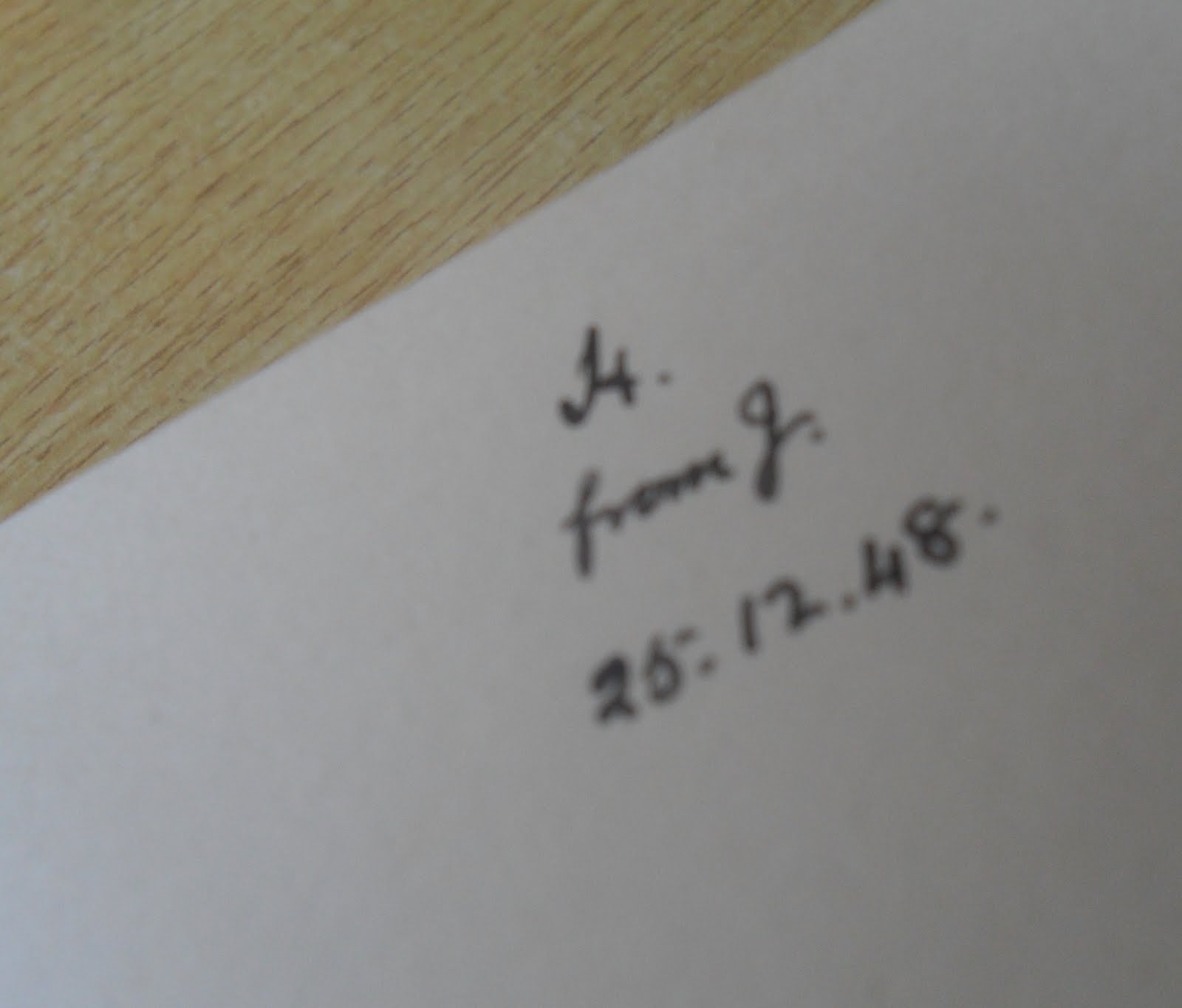
Found Jane Austen by Elizabeth Jenkins in my local second hand bookshop. I'm intrigued by the handwritten inscription and very much hope that "H" was fond of Austen and delighted to receive this book as a gift from "J" on Christmas Day, 1948.

While I think that Claire Tomalin's Jane Austen -A Life is the definitive Austen biography, Elizabeth Jenkins' uses her experience as a novelist to provide a unique insight into Austen's genius and her polished style makes this book a real pleasure to read.

When Jenkins' describes 'the brilliant perfection of Pride and Prejudice, sixteen years maturing in the mind of an unequalled artist' and the 'peculiar loveliness of Sense and Sensibility' it makes you want to immediately re-read them.

Talking of which, this year is the 200th anniversary of the publication of Sense and Sensibility. Anyone planning a re-read?

Friday, 14 January 2011

Coquelicot

'Do you know, I saw the prettiest hat you can imagine, in a shop window in Milsom Street just now - very like yours, only with coquelicot ribbons instead of green; I quite longed for it.' Isabella, Northanger Abbey
I've been reading Susannah Carson's collection of essays on Jane Austen and some of the selected letters. I've been fascinated with all the detail about fabrics and dress-making. In a letter to Cassandra dated 1798, Austen describes a hat she is customising and her intentions to replace the black feather with a coquelicot one 'and besides coquelicot is to be all the fashion this winter.'

Coquelicot was one of the fashionable Regency colours - a bright orange-red like a poppy. I love the fact that Austen was interested in clothes and fashion and I've learned that persian was used to line dresses, sarsenet is a fine soft silk and cambric is a white linen. Who knew?!