Showing posts with label Barbara Kingsolver. Show all posts

Friday, 13 May 2016

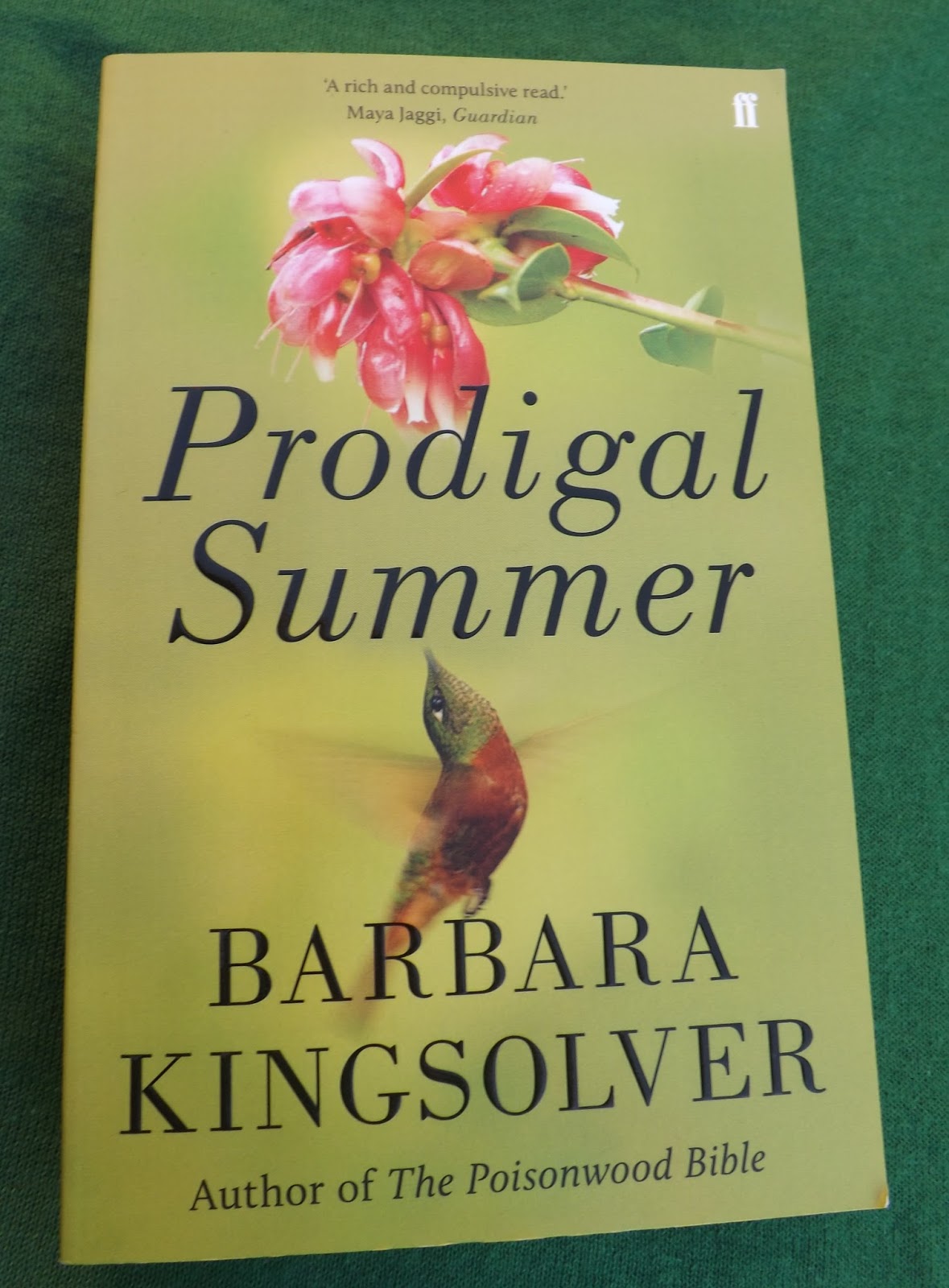
Prodigal Summer


Whether she is portraying cereus the night-blooming cactus flower in The Bean Trees or the stupefying heat and exuberance of the African Congo in The Poisonwood Bible, Barbara Kingsolver writes fine literary fiction. I’ve just read Prodigal Summer and fallen in love with the Appalachian landscape of lunar moths and coyotes and wild honeysuckle. Adriana Trigiani’s lovable Big Stone Gap series was set in the Appalachian mountains of Virginia and I think The Hunger Games, too.

Like The Poisonwood Bible, the narrative switches between three characters in Prodigal Summer - newly-widowed Lusa, touchy forest ranger Deanna and Garnett an octogenarian engaged in permanent warfare with his neighbour. Kingsolver wears her extensive knowledge of the wildlife of the mountains and the hardships faced by the rural community lightly and builds a satisfying story with high comedy in a particular incident with a snapping turtle!
 
Deanna doesn’t like people very much and prefers to live in a remote forest cabin tracking the coyotes that are re-populating the area. She does rather like the handsome hunter she runs across and their passionate relationship is echoed by the overblown summer. My favourite character though is former entomologist, Lusa, who is left to put her academic knowledge to practical use on the rural farm she inherits after her husband’s death. It is hinted that her marriage was not entirely happy and Lusa has to face hostility from some of her husband’s sisters while occasionally fending off amorous attentions from some of her husband’s male relatives. The chapters featuring Lusa are called ‘Moth Love’ and her passion for moths is beautifully portrayed.
An Io moth rested on the screen, her second-favourite moth, whose surprising underwings were the same pinkish-gold as her hair.
 It think I may have a prodigal summer of my own with a pile of Kingsolver novels and hopefully some warm weather to sit in the garden!

Sunday, 7 June 2015

Euphoria


Just back from a bright and breezy weekend in Brighton and Hove. One of the pleasures of Brighton is the big Waterstones which has five floors and a nice coffee shop on the top floor where you can glimpse the sea.  I bought Lily King’s Euphoria which has been top of my wishlist for a while. I knew when I read the reviews and blog posts that a 1930's love story set on the Sepik river based on the early life of the anthropologist Margaret Mead would be just the kind of literary novel I enjoy.

Christmas Eve, 1932.  Fen and his wife Nell, anthropologists studying the river tribes of Papua New Guinea, board a boat intending to leave the country. Wearing filthy clothes, suffering from tropical sickness and nursing cuts and bruises they contrast with the other couples on the boat, the ladies in stiff party dresses and men in dinner jackets passing around gin. From a conversation with the women on the boat Nell learns that a book she has published has caused quite a stir in her home country.

At the clubhouse they meet Bankson another renowned anthropologist who has been working with the Sepik river tribes for many years. Lonely and traumatised by the loss of his brothers Bankson is drawn to Nell and tends her wounds and persuades them both to stay on and work with another tribe. Thus begins a bitter love triangle between Nell, her handsome and manipulative husband Fen who ‘smells of Cambridge and youth’ and the kind-hearted and vulnerable Bankson. 
 
I should say that the character of Nell is only loosely based on  Margaret Mead and she is attractively drawn as a perceptive, methodical and hardworking scientist with an affectionate heart. I loved the description of Nell re-telling the story of Romeo and Juliet to the Tam tribe who find it hysterically funny.   
 
When a talented writer breaks away from ‘domestic fiction’ there a huge creative possibilities. I’m thinking of Ann Patchett’s State of Wonder and Barbara Kingsolver’s The Poisonwood BibleEuphoria is the best novel I've read this year.  There is an excellent Vogue interview with Lily King here if you can get past all the ads.  Cluttering literary interviews with fashion ads is sooo last year dahling! 

Tuesday, 27 March 2012

Bird Cloud

Above the snooty sink hung a mirror with high-wattage bulbs blazing straight into one's face rather like something John Gielgud might have had in his dressing room. For an aging woman it was frightening rather than useful. Annie Proulx
I like the fact that this book is a memoir rather than an autobiography. Annie Proulx focuses on a particular event in her life - the construction of her house at Bird Cloud near Medicine Bow in Wyoming. She wanted a house built to her specifications, using natural materials where possible, with plenty of space for her large collection of books. She wanted to be able to write without interruption, spread out old maps and photographs, view the cliff face in the changing light and watch the eagles from her window.

Unfortunately, things didn't go quite to plan. There were problems with builders, architects and sub-contractors, spiralling expenses and long, long waits for materials to arrive and work to be completed. Not to mention the fact that the area is isolated and exposed to high Wyoming winds. Bird Cloud is on the North Platte River near the town of Saratoga on the western slope of Medicine Bow. The wildlife is spectacular and Proulx weaves in details of a clever mountain lion, tagging elks for a conservation project and a whole chapter about pine cones. This book reminds me a little of The Blue Jay's Dance by Louise Erdrich and has reawakened my interest in Annie Proulx. A few years ago I read several of her novels back to back and then got a bit depressed with the grim realities of life for ranchers, cowboys and drifters. One can only stand so much reality!

Now I want to re-read her wonderful novel The Shipping News.
I also have Barbara Kingsolver's Homeland to read and my author of the month is that queen of American landscape writers Willa Cather. Fabulous picture of her, don't you think?

Monday, 7 December 2009

The Lacuna

Slightly frustrating when you pay £14.99 for a book, struggle to page 150 before realising you really don't care that much about the central character or his mother or anyone else in the novel and shove it back on your shelf with a vague plan of returning to it someday (knowing you never will). But that's the chance you take with fiction.

The Poisonwood Bible is one of my favourite novels and I was hoping The Lacuna would work some of the same magic. Set in Mexico in the early part of the twentieth century it is a coming of age story and combines fictional characters with historical characters of the era, for example, the artists Frida Kahlo and Diego Rivera. I don't think it works. Barbara Kingsolver is a wonderful writer but this novel struck me as over-researched.

However, I'm reading Admission by Jean Hanff Korelitz right now. It is so good I've been reading into the early hours and suffering for it the next day as articulated in this blog post by Louise Erdrich. 'Severe maternal inertia' indeed!

Sunday, 8 November 2009

Beloved Books

Man oh man, are we in for it now, was my thinking about the Congo from the instant we first set foot.
Thus speaks Rachel Rebekah Price the 'extreme blonde' in The Poisonwood Bible. Fifteen-years old and completely self-centred she unwillingly spends a year in a remote village in Africa with her missionary father, mother and three sisters, Adah, Leah and Ruth May. Pretty tough for a girl 'whose only hopes for the year were a sweet sixteen party and a pink mohair twin set.'

The Poisonwood Bible is a fabulous novel. I loved Methuselah, the African Grey parrot, who has learned to swear from the previous missionary ('Piss off, Methuselah!') and the early scene where Nathan tries to cultivate the African soil. Arrogantly chopping down orchids to make way for beans and tomatoes he falls foul of the poisonwood tree which brings him out in a weeping, welted rash.

In her introduction to this edition Barbara Kingsolver says that she waited nearly 30 years for the wisdom and maturity to write this novel. It's a beautiful evocation of Africa.