 Marianne Joan Elliott-Said, 3 July 1957-25 April 2011
Wednesday, 27 April 2011

Monday, 25 April 2011
The Hundred Secret Senses
 I've always intended this blog to be about beloved books which are passed down through the generations from mother to daughter. This female focus is particularly apt when reading Amy Tan. I've read and re-read everything she has published and I can quote huge chunks of my favourite novel The Hundred Secret Senses.
Olivia Yee grows up with her family in San Francisco. Steeped in American culture she is less than pleased when her older half-sister comes from China to live with them. Kwan has extraordinary powers and senses - she can diagnose and heal by touch, when she tries to wear a digital watch the numbers whizz around, she can sense with pinpoint accuracy electrical faults in a circuit and she can talk to the dead. Kwan is a source of constant irritation to Libby:
Kwan has never been able to correctly pronounce my name, Olivia. To her, I will always be Libby-ah, not plain Libby, like the tomato juice, but Libby-ah, like the nation of Muammar Qaddafi. As a consequence, her husband, George Lew, his two sons from a first marriage, and that whole side of the family all call me Libby-ah too. The 'ah' part especially annoys me. It's the Chinese equivalent of saying 'hey,' as in 'Hey Libby, come here.' I asked Kwan once how she'd like it if I introduced her to everyone as 'Hey, Kwan.' She slapped my arm, went breathless with laughter, then said hoarsely, 'I like, I like.' So much for cultural parallels, Libby-ah it is, forever and ever.As the novel unfolds, Libby learns to love and appreciate the wonderful Kwan. If you are new to Amy Tan, I would suggest reading the novels chronologically. Start with the Joy Luck Club, then The Kitchen God's Wife - watch out for the wonderful Ding Ho Flower Shop - and then The Hundred Secret Senses.
Monday, 18 April 2011
Catherine Morland
 'Catherine grows quite a good-looking girl, - she is almost pretty today,' were words which caught her ears now and then; and how welcome were the sounds! To look almost pretty, is an acquisition of higher delight to a girl who has been looking plain the first fifteen years of her life, than a beauty from her cradle can ever receive. Jane Austen, Northanger Abbey
 With the exception of Jane Eyre it is rare to find a literary heroine who is not beautiful. During her six-week sojourn in Bath, Catherine Morland a likeable and unremarkable girl who takes everything at face-value is rewarded with her man while the artful, the fashionable and the foolish are the victims of Austen's biting satire. Northanger Abbey also contains a delightful defence of the novel and novel readers (as if we needed one!)
The beauty on the cover of my Everyman's edition is Priscilla Jones, Wife of the Artist by Thomas Barker of Bath (1769-1847).
Friday, 8 April 2011
American Literature
 I must stop buying these fancypants editions of literary classics because they are twice the price of standard paperbacks. It's the bookish equivalent of Carrie in Sex and the City when she spots another pair of Jimmy Choos!
Ethan Frome is a relentlessly tragic novel and portrays a completely different view of New England to Sarah Orne Jewett's The Country of the Pointed Firs. The tortured relationship between Ethan, his wife Zeena and the young Mattie Silver plays itself out to its shocking conclusion.
Talking of toxic marriages Shadow Tag is an unflinching portrayal of the relationship between Gil, an artist and his wife Irene who is also his muse. Both are flawed. He can't control his temper and she is a loving mother but a cold-hearted wife. Irene keeps a 'false' blue diary which she leaves around for her husband to read while her real thoughts are recorded in a secret red diary. Shadow Tag could not be considered a comfort read and this marriage turns uglier than most bad marriages with alcohol playing its inevitable part, but sometimes you need to read about real life, as it is, both good and bad and Louise Erdrich excels at writing real life.
After all that tragedy I need some Austen.
Wednesday, 30 March 2011
Shadow Tag
 Waterstone's no longer seem to stock the latest Louise Erdrich titles. Plenty of shelf space for charmless celebrity biographies, but no space for a fine contemporary American writer. I suppose it is market driven. Here in the UK I have to order Erdrich's latest novels when I find out about them from blogger friends who are also fans, such as Frisbee Wind or from the website for Erdrich's bookshop Birchbark Books.
 If you are new to this writer I would suggest starting with Love Medicine or, my favourite, The Beet Queen. Her novels are not for the faint-hearted - I don't mean that they are gruesome - I mean that many of them examine the harsh realities of life for those living on and around the reservations. Shadow Tag arrived last week and I started reading on Sunday night. Something nice about beginning a much-anticipated novel on a Sunday - kind of sets you up for the week!
Finished The Historian. I thought it was very well-written but could have been edited by at least 200 pages for a sharper story. Too much travel and history and not enough character development for my tastes. That said, it genuinely made me jump a couple of times and there was some beautiful descriptive writing:
At farms along the road we stopped to buy picnics better than any restaurant could have made for us: boxes of new strawberries that gave off a red glow in the sun and seemed not to need washing; cylinders of goat's cheese weighty as barbells and encrusted with a rough grey mould as if they'd been rolled across a cellar floor.
Saturday, 19 March 2011
The Historian
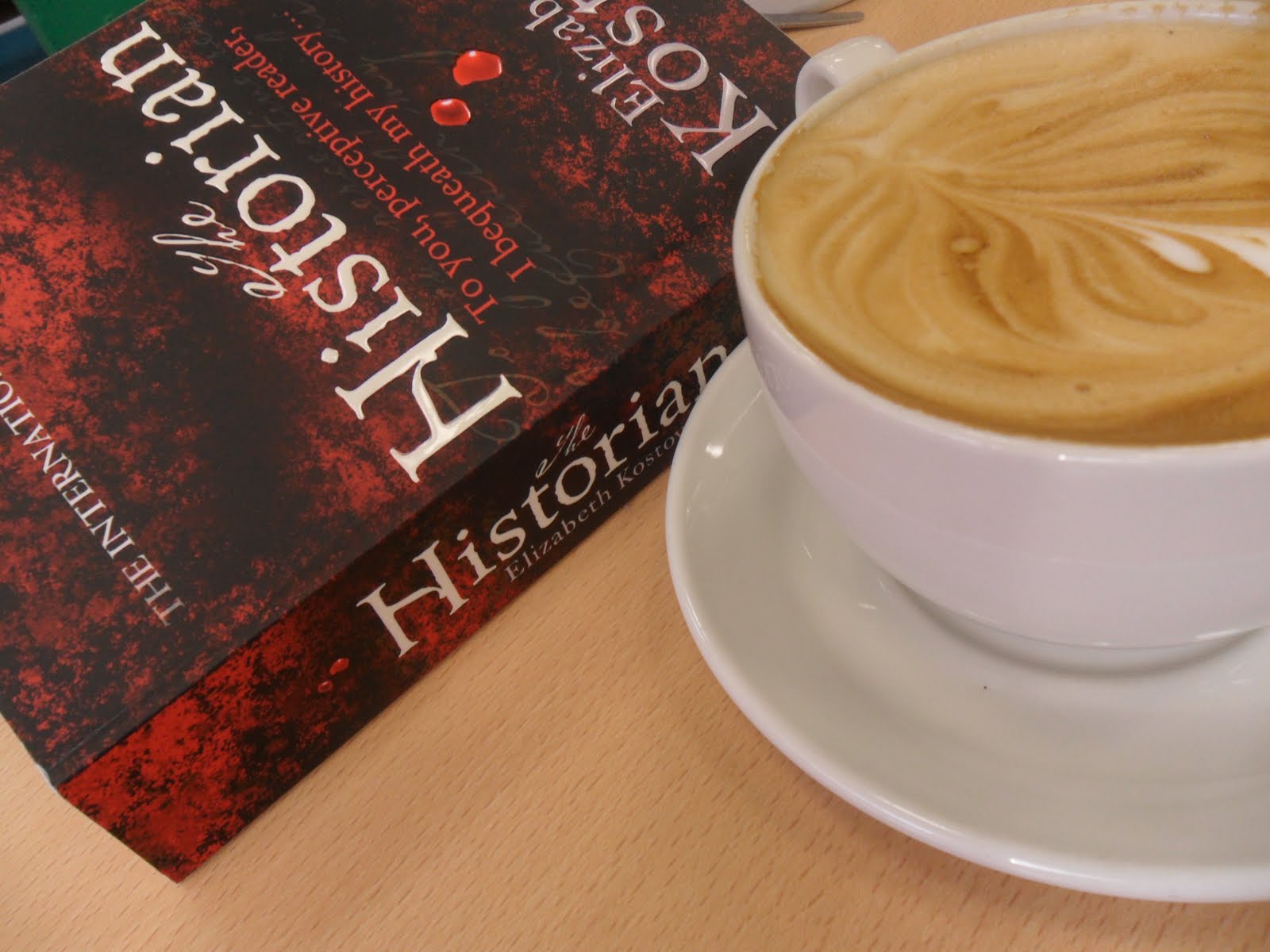
About time I rejoined the 21st century for a while with a contemporary novel. I do like novels set in academia so I was pleased when my reading group chose Elizabeth Kostova's The Historian for March.
I was immediately drawn in by the opening of this novel. An ancient book mysteriously appears on a student's desk and reappears when he returns it to the rare books section of the university library. There there is the mysterious disappearance of the charismatic professor who had been researching the history of Dracula and only a smear of blood is left on the ceiling of his study. The papers and letters he leaves behind are all addressed to 'My dear and unfortunate successor.'
I'm only a couple of hundred pages in - this novel is 700 pages long(!) - but I'm enjoying the elegance of the writing. I'm not particularly interested in the legend and history of Dracula per se but so far the novel is holding my attention.
I was sorry to see that Jane Brocket is wavering about whether to continue her inspiring blog. I have to say that I've never found the book blogging community to be anything other than positive and mutually supportive. Possibly because reading is a non-competitive activity?
Friday, 11 March 2011
Sense and Sensibility 200th anniversary post (1)

Elinor Dashwood is my favourite Austen heroine and each time I read Sense and Sensibility I discover something new about her. Austen was possessed of what Elizabeth Jenkins refers to as 'the occult power of creating human personality - the rarest form of literary genius.' Depth and nuance of character which may not be apparent on first reading an Austen novel are revealed upon re-reading.Have you read Sense and Sensibility? It is a clever novel. They were full of it at Althorpe, and although it ends stupidly I was much amused by it. Letter from Lady Bessborough to Lord Granville Leveson-Gower, 1811
Surprisingly, Elizabeth Jenkins was not fond of Elinor. She describes her as 'too rational.' I would argue the Elinor is the only character who keeps it together and retains a sense of humour despite almost unbearable provocation. Marianne falls to pieces when she is abandoned by Willoughby and it is Elinor who supports her while she is simultaneously aware that the man she loves is secretly engaged to the loathsome Lucy Steele who never misses an opportunity to remind her.
Yet when Marianne goes into raptures about autumn leaves, Elinor can dryly remark. 'It is not everyone who shares your passion for dead leaves.' When Lady Middleton's noisy, spoilt children pull their mother and damage her clothes, Elinor remarks that she 'never thinks of tame and quiet children with any abhorrence.'
Whether the novel ends 'stupidly' depends I suppose on your opinion of Edward Ferrars. I still find him a bit of a sap and think perhaps Colonel Brandon would have been a better match for Elinor.
I know you all have busy reading schedules but if anyone gets the time to re-read S&S this year I'd love to know your thoughts!
Subscribe to:
Posts (Atom)